How to Choose the Right Cargo Cover for Your Vehicle: GPCA's Ultimate Guide
A cargo cover looks simple until you try to choose one. Then the questions start: Will it fit my hardtop? What about topless use? Does it block tall cargo? Is a soft cover actually useful?
The right answer depends on how you use your vehicle. A daily driver who wants privacy needs something different from a topless Jeep owner carrying camping gear, a dog, and a cooler on the same weekend. Here's how to sort it out.

Start with the real job of a cargo cover
The first job is privacy. A tinted window can still reveal shapes and bags. A loose tarp usually announces that something is being hidden. A fitted cargo cover creates a cleaner visual barrier and discourages casual attention whether you're parked at a trailhead or a city lot.
The second job is flexibility. Good cargo space changes from day to day — groceries one trip, a dog and a toolbox the next. That's where a foldable, modular cover earns its place over a rigid box that permanently limits what you can carry.
GPCA Cargo Cover LITE — simple privacy for everyday use
The LITE version is the clean choice for owners who mainly want valuables out of sight under a hardtop or soft top. It's lightweight, folds away quickly, and doesn't permanently take over the cargo area. LITE works best when privacy is the primary goal and the roof stays in place most of the time.
GPCA Cargo Cover PRO — built for more configurations
The PRO upgrades to a double-layer structure, wider support straps, a reversible appearance, and a MOLLE-style surface for compatible accessories. It's designed for both top-on and topless use — the better choice for owners who regularly change their setup. The PRO's flexible design also lets you free one side of the cargo area while keeping the other covered, which matters when a dog needs room or a tall item won't fit under the cover.
Freedom Pack — privacy plus organization
The Freedom Pack adds a GPCA organizer to the cargo-cover system. The organizer can serve as a cargo divider, tailgate-mounted panel, or accessible storage pouch depending on how you install it. Choose the Freedom Pack when you want a more complete cargo-management setup rather than privacy alone.
Vehicle fitment — why this matters more than you think
A cover that's slightly too short leaves a gap at the tailgate, defeating most of the privacy benefit. For Jeep Wrangler and Gladiator, you also need to account for spare tire placement, tailgate hinge geometry, and two-door vs. four-door configurations. Here's the quick reference:
Jeep Wrangler JL / 4xe, hardtop — LITE or PRO. Choose by privacy vs. topless versatility. Uses factory hardtop bolts or GPCA quick-release anchors.
Jeep Wrangler JL / 4xe, soft top — Soft-top package or PRO for more flexibility. Requires M8-1.25 hardware or compatible quick-release anchors.
Jeep Wrangler JK, hardtop — LITE or PRO (PRO is stronger and more configurable). Uses factory bolts, D-rings, or D-Plates.
Jeep Wrangler JK, soft top — PRO recommended. Adjust rear straps for the folded soft top. Uses M8-1.25 hardware.
Ford Bronco 2021+ — Use the Bronco-specific cover with model-specific hardware.
Sky One-Touch Wrangler — Requires special installation planning; tub-edge holes may be covered by side panels and additional M8 nuts may be needed.
Installation basics
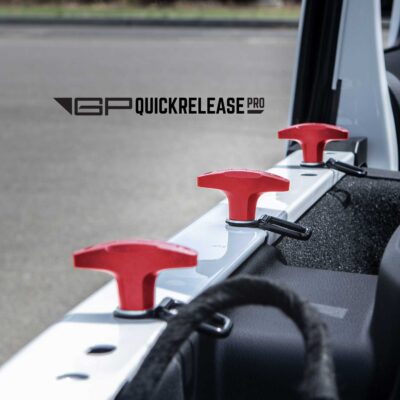
JL installations commonly use a T50 Torx when factory hardtop bolts are present. JK installations commonly use a T40 Torx. Quick-release Anchor PRO fasteners can make repeated roof and cover changes much faster — no tool required.
Soft-top owners: verify mounting-hole access and use the correct M8-1.25 hardware. Balance the straps rather than overtightening one area — a flexible cover should be supported evenly across the frame.
Hard cover vs. flexible cover
A hard cargo box provides rigid security but permanently limits vertical cargo height. A flexible cover gives you privacy, fast removal, compact storage, and multiple configurations. The decision comes down to whether you prioritize rigid security or adaptable space — not which option is universally better.
The full cargo system
A cargo cover works best as part of a system. Pair it with GPCA Anchor PRO D-ring tie-down anchors to keep loads secured under the cover, and a GP-Star for overhead management of lighter items above. Together they convert a bare cargo area into something organized, protected, and trail-ready.
Choose LITE for simple privacy under the roof. Choose PRO when you go topless, carry more gear, or want reversible and MOLLE-style features. Choose Freedom Pack when organization matters as much as privacy. The best cargo cover is the one that disappears when you don't need it and becomes useful the moment you do.